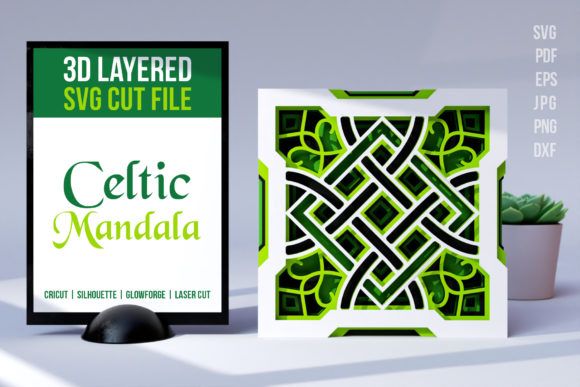
The Art and Engineering of Celtic Mandala 3D Layered Design
Few visual traditions carry the symbolic weight of Celtic knotwork, and fewer still translate into dimensional form as compellingly as the Celtic Mandala 3D Layered approach. By combining the intricate interlacing patterns of ancient Celtic art with the geometric symmetry of mandalas — and then adding physical depth through layered construction — creators produce objects that are simultaneously meditative, decorative, and technically sophisticated. This synthesis is not merely an aesthetic exercise; it represents a convergence of cultural heritage, precise engineering, and modern digital fabrication that appeals to a remarkably diverse audience.
Understanding the Layered Construction Method
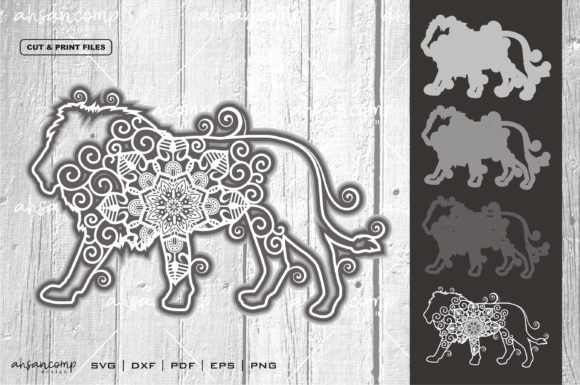
At its core, a Celtic Mandala 3D Layered piece is built by stacking multiple precisely cut planes, each containing a portion of the overall pattern. When assembled, these layers create shadows, highlights, and a sense of depth that a flat image cannot achieve. The technique borrows from papercut art, laser engraving, and architectural model-making, but the distinctive visual language remains rooted in the endless loops and interwoven paths characteristic of Celtic design.
Each layer typically serves a specific structural or visual role:
- The base layer provides stability and often carries the outermost ring of knotwork or geometric framing.
- The intermediate layers introduce the central mandala motifs — concentric circles, radial symmetry, and interlocking triskelions or triquetras.
- The top layer often features the most intricate cutwork, sometimes including negative space that reveals the layers beneath.
By varying the spacing between layers — using spacers or mounting pins — the designer controls the cast shadows, which shift throughout the day as ambient light changes. This dynamic quality is one of the most engaging characteristics of the format.
Material Choices That Shape the Final Piece
The selection of material dramatically influences both the appearance and the durability of a Celtic Mandala 3D Layered creation. Each substrate brings its own tactile and visual properties:
- Wood veneers — Baltic birch, mahogany, or walnut offer warmth and natural grain that complements the organic feel of Celtic patterns. Lighter woods emphasize shadow contrast, while dark woods create a more subdued, mysterious depth.
- Acrylic sheets — Clear, frosted, or colored acrylic allows backlighting, which transforms the mandala into a luminous centerpiece. Edge-lit acrylic versions are particularly popular for modern interiors.
- Cardstock or kraft board — Affordable and lightweight, these materials are ideal for prototypes, educational projects, or small-scale decorative items. They also appeal to hobbyists working with manual cutting tools.
- Metal panels — Aluminum or brass provide a premium feel and are often used for wall art in commercial or luxury residential settings. The reflective surfaces interact with light differently than opaque materials.
Designers frequently combine materials within a single piece — for example, a wood base with acrylic upper layers — to exploit the strengths of each. The contrast between a matte wooden foundation and a glossy translucent top layer can produce striking visual tension.
Who Engages with This Craft
The audience for Celtic Mandala 3D Layered work spans several distinct communities, each approaching the format from a different angle:
Digital Fabrication Specialists and Makers
Laser cutters, CNC router operators, and 3D-printing enthusiasts are perhaps the most active producers. For them, the challenge lies in translating a continuous interlaced design into discrete layers that align perfectly. Software tools like LightBurn, Fusion 360, or Inkscape with the Gcodetools extension are commonly used to generate cut files. The key technical consideration is kerf compensation — accounting for the material removed by the laser or bit — so that layers fit together without gaps or excessive friction.
Educators and Workshop Facilitators
Art teachers, math instructors, and cultural studies educators use these mandalas to demonstrate principles of symmetry, recursion, and historical design systems. A Celtic Mandala 3D Layered project serves as a tangible example of how geometry appears in cultural artifacts, making abstract mathematical concepts more accessible. Students gain exposure to both heritage art forms and modern fabrication workflows in a single exercise.
Interior Designers and Homeowners
As decorative objects, these layered mandalas fill a specific niche: they are intricate enough to serve as focal points but restrained enough to complement contemporary minimalism. Designers appreciate that the same pattern can be scaled to different sizes and finished in various materials to suit a particular room's palette. Backlit versions are increasingly specified for entryways, meditation spaces, and hospitality environments where ambiance matters.
Spiritual and Wellness Practitioners
Yoga studios, meditation centers, and individuals seeking contemplative decor are drawn to the mandala aspect specifically. The circular geometry has long been associated with focus and introspection, and the three-dimensional layering adds a physical depth that mirrors the idea of inner exploration. A Celtic Mandala 3D Layered piece in a quiet corner of a room can subtly anchor the space.
Design Considerations for Effective Layering
Creating a successful layered mandala requires more than simply copying a Celtic knot into a CAD program. Several design principles directly affect the final outcome:
- Path continuity — Celtic knots are defined by a single continuous line (or a small number of lines) that weave over and under themselves. In a layered format, the designer must decide whether each layer represents a full segment of the path or whether the illusion of interlacing is created by splitting the path across layers. The latter approach often yields more convincing depth.
- Shadow gap planning — The distance between layers should be calculated based on the material thickness and the desired shadow width. A gap that is too narrow produces indistinct shadows; too wide, and the layers appear disconnected rather than integrated.
- Structural bridging — Intricate cutouts can leave fragile islands of material. Designers must incorporate hidden bridges or adjust the pattern so that every shape remains attached to the surrounding frame. This is especially important for materials like wood that can crack under stress.
- Alignment registration — Precise alignment is non-negotiable. Most practitioners use alignment tabs or pin holes that correspond across all layers. For stacked constructions, dowels or threaded rods can provide both alignment and compression.
A Typical Workflow from Concept to Finished Object
While every creator develops their own process, a common sequence emerges when producing a Celtic Mandala 3D Layered piece:
Phase 1 — Pattern sourcing or creation. The designer either traces a traditional Celtic motif (with attention to copyright and cultural respect) or generates an original interlaced pattern using vector tools. Many start from a symmetrical radial grid and build knotwork by connecting nodes in repeating sequences.
Phase 2 — Layer decomposition. The complete pattern is divided into two to five layers. This step requires visualizing how the pattern will be reassembled. Some designers work from back to front, placing the most open, airy cuts on the top layer and the densest framing on the bottom.
Phase 3 — Test cutting. Inexpensive materials like cardstock or thin plywood are used to verify alignment and visual effect. At this stage, adjustments to gap spacing, bridge placement, and overall scale are made before committing to premium materials.
Phase 4 — Final fabrication and finishing. Once the design is validated, the final material is cut. Edges may be sanded, painted, or left natural. The layers are assembled with spacers — which can be simple washers, 3D-printed rings, or integrated standoffs — and mounted on a backing board or within a shadow box frame.
Phase 5 — Lighting integration (optional). For acrylic or translucent builds, LED strip lighting or edge-lit panels are added behind or beside the layers. The result is a piece that changes character dramatically when the lights are on versus off.
Advantages Over Traditional Flat Representations
The shift from a printed or painted Celtic mandala to a Celtic Mandala 3D Layered version offers several tangible benefits:
- Engagement with light — Cast shadows and translucency create a living artwork that evolves throughout the day. No two viewing angles look exactly the same.
- Tactile dimensionality — The physical depth invites closer inspection. Viewers naturally move around the piece, discovering how the layers separate and recombine from different perspectives.
- Perceived value — The visible craftsmanship and material substance of a layered object often command higher perceived worth than a flat print, whether for sale or for personal satisfaction.
- Customizability — Because the design is broken into layers, individual planes can be swapped or recolored independently. A creator might offer multiple top-layer variations for the same base design.
Practical Challenges and How to Address Them
No technique is without its difficulties. Practitioners of Celtic Mandala 3D Layered construction commonly encounter these hurdles:
Material warping. Thin wood or acrylic can bow over time, especially if exposed to humidity or temperature fluctuations. Mitigation strategies include using thicker stock for the base layer, sealing the material with a stable finish, and incorporating a rigid backing or frame that holds all layers in compression.
Dust accumulation between layers. The gaps that create beautiful shadows also collect dust. Sealing the edges of the assembly with a slim bezel or enclosing the piece in a shadow box with a glass or acrylic front prevents debris from settling between planes.
Pattern complexity vs. cutting time. Highly detailed layers with many small cutouts can require hours of laser or router time, raising production cost significantly. Designers must balance intricacy with practicality. One approach is to reserve the most detailed cuts for the top layer only, keeping lower layers simpler.
Emerging Trends in Layered Celtic Mandala Art
The field continues to evolve as new tools and ideas emerge. Several trends are shaping the direction of Celtic Mandala 3D Layered work:
Parametric generation. Designers are writing scripts that generate Celtic-style interlacing algorithmically. By adjusting parameters like strand width, turning angle, and symmetry order, they can produce an infinite family of variations from a single rule set. These designs are then automatically decomposed into layers, greatly speeding up production.
Hybrid physical-digital pieces. Some creators embed NFC tags or QR codes within the assembly that link to videos of the mandala being assembled, or to background information about the specific Celtic motif used. This bridges the gap between a physical object and digital storytelling.
Sustainable and reclaimed materials. As environmental awareness grows, makers are turning to reclaimed wood, recycled acrylic, and biodegradable substrates. A mandala made from salvaged floorboards or discarded signage carries an additional narrative of renewal that resonates with eco-conscious buyers.
Collaborative design libraries. Online communities now share layered mandala files under open licenses, allowing others to remix and adapt patterns. This has accelerated the spread of techniques and reduced the barrier to entry for newcomers.
Selecting the Right Approach for Your Project
Whether you are a maker evaluating your first layered build or a buyer looking for a distinctive wall piece, a few questions can guide your decision:
- What is the intended setting? Direct sunlight near a window? Low-light hallway? — This dictates material and whether lighting integration is needed.
- What scale and viewing distance are expected? Large pieces with bold shapes read well across a room; small pieces reward close inspection with fine detail.
- What is the budget for materials and fabrication time? Metal and thick acrylic cost more and take longer to cut than plywood or cardstock.
- How important is cultural accuracy? If the piece is meant to honor Celtic traditions, careful research into authentic knotwork patterns and their meanings adds depth to the design.
The Celtic Mandala 3D Layered format occupies a rare intersection: it satisfies the craftsperson's desire for precision, the artist's need for expression, the educator's search for teachable moments, and the homeowner's wish for meaningful decoration. Its layered nature mirrors the layered histories and meanings embedded in Celtic art itself — visible, hidden, and always connected in an endless loop.